
"Kumihimo loops"—what are they? Why CoCoon adopted this feature and its identity

COCON doesn't just want to make solid ties.
We strip away.
We don't add anything unnecessary.
A quiet, dignified presence.
However, if we pursue only this,
our products would eventually become "anonymous."
We sought a "symbol" that resides within the quietness.
Details that make you immediately recognize "This is COCON," even without a brand tag.
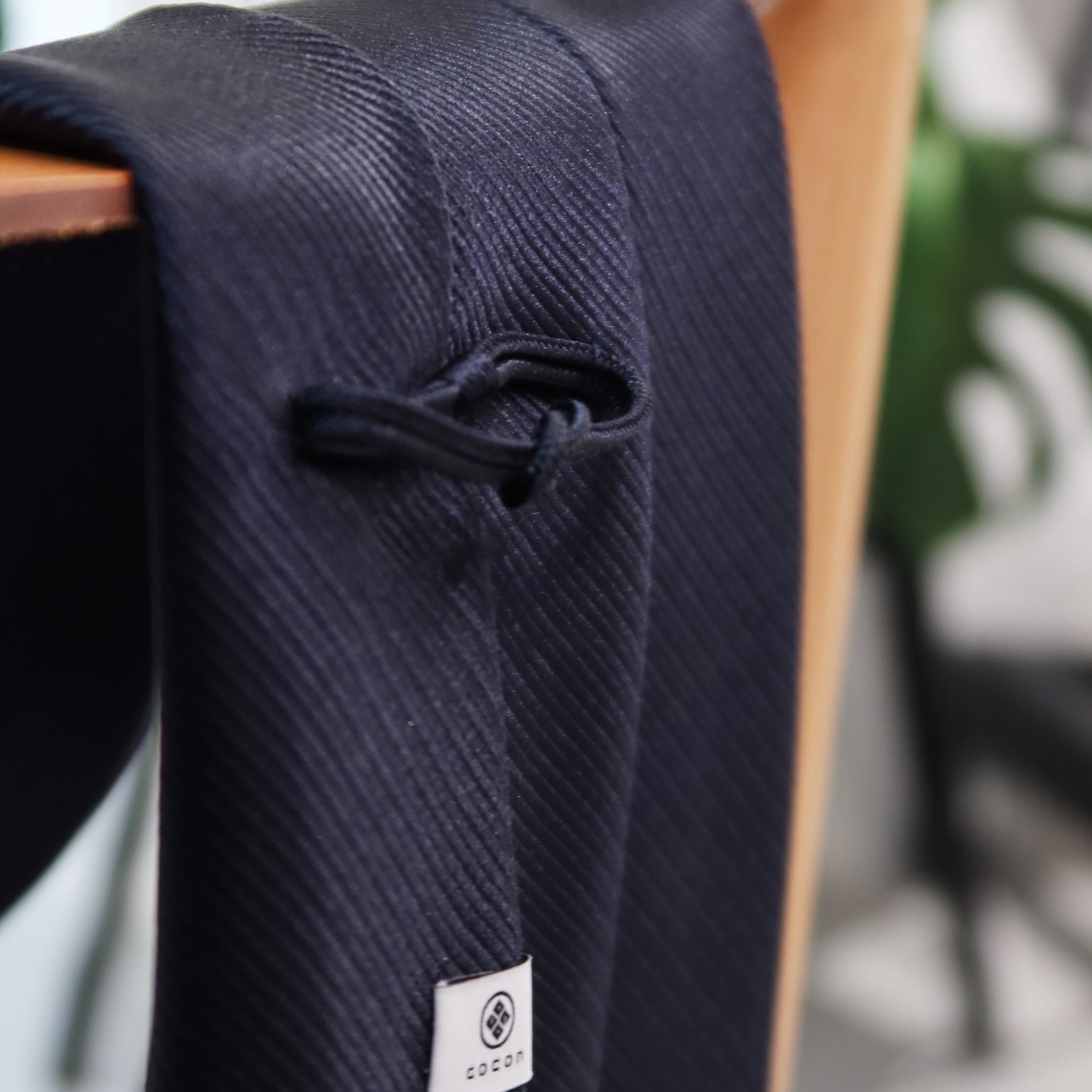
The answer was an updated co-loop (small blade keeper).
Why a "braided cord"?

Typical ties have loops made from the same fabric as the main body.
This is a rational, beautiful, and time-honored specification.
However, COCON wanted to imbue it with another layer of meaning.
A tie is something that is "tied."
And we advocate "weaving and tying, people and things."
Then,
shouldn't the loop also be a "cord"?
What we arrived at was "kumihimo" (braided cord), an ancient Japanese technique.
Redesigning from scratch with a long-established Kyoto company

In rebooting COCON,
the design of this loop took the most time.
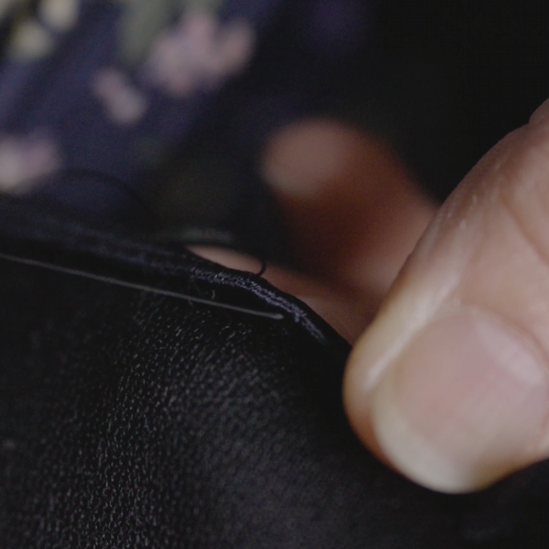
We consulted with a long-established kumihimo shop in Kyoto,
and went through countless prototypes.
However, we quickly ran into a wall.
Traditional kumihimo threads are often used for small items,
so their colorfastness was not sufficient for tie use,
and there was a risk of color transfer due to sweat.
Beauty alone does not make a product.
So, we consulted with the weaving factory that weaves the tie body.

We arranged for tie-specific threads with high colorfastness,
and chose the unprecedented process of making kumihimo with those threads.
We are nothing but grateful to the artisans who understood our passion and willingly accepted the challenge.
Kaku-Yatsugumi and Tsuri-Yotsugumi

Once the material was decided, the next step was the braiding method.
There are countless braiding methods for kumihimo.
Hardness, appearance, luster, tightness.
We made many prototypes,
attached them to actual ties,
tied, untied, touched, and confirmed.
Among them, we selected:
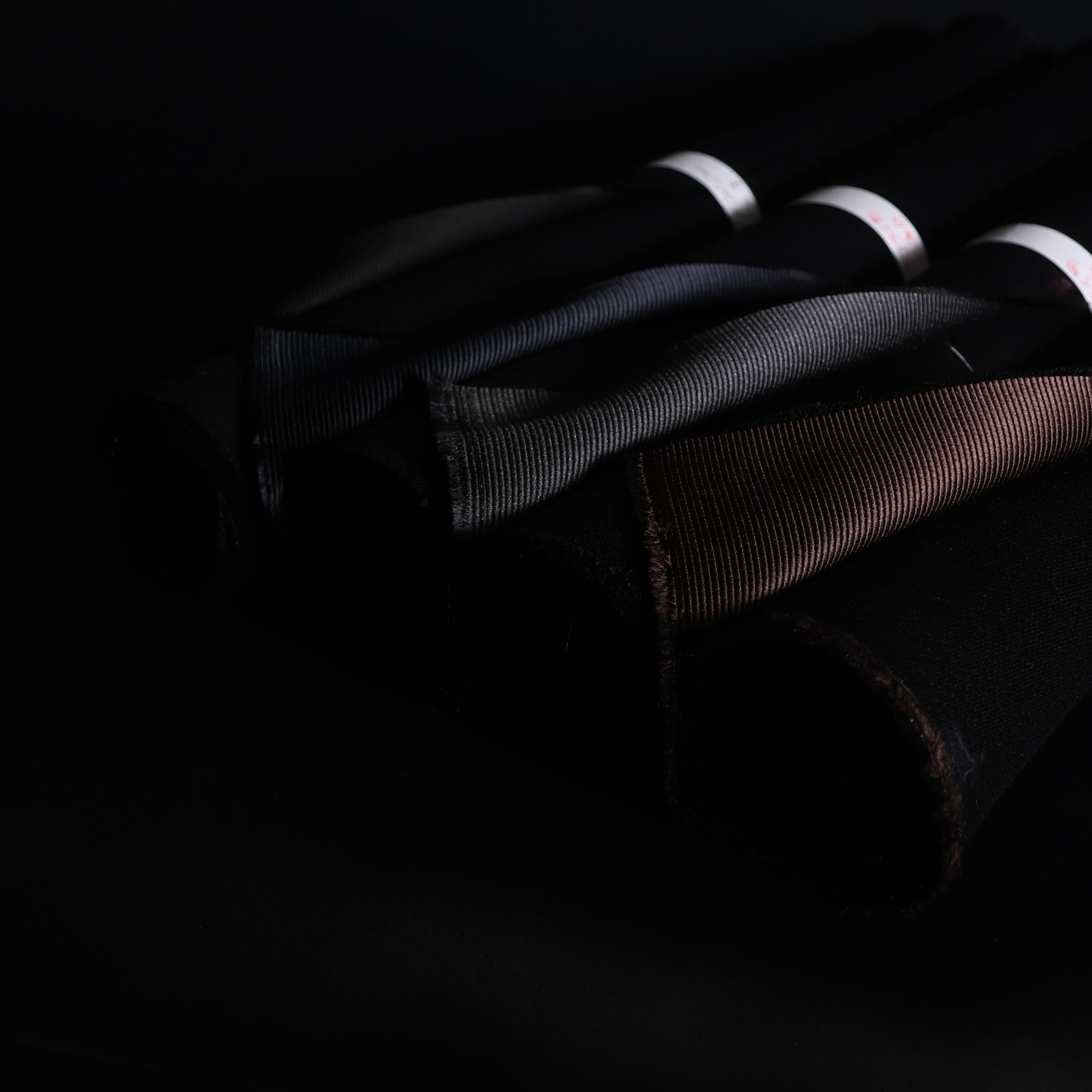
- Kaku-Yatsugumi (square eight-braid)
- Tsuri-Yotsugumi (hanging four-braid)

Considering thickness and braid design,
compatibility with the tie body,
appropriate stiffness and flexibility,
and actual feel when used.
And the final answer we arrived at was the specification of tying two braided cords with a square knot.
Although the cost would increase,
for us, who aim for the absolute best,
there was no hesitation.
A symbol needed meaning.
Weaving, bundling, tying

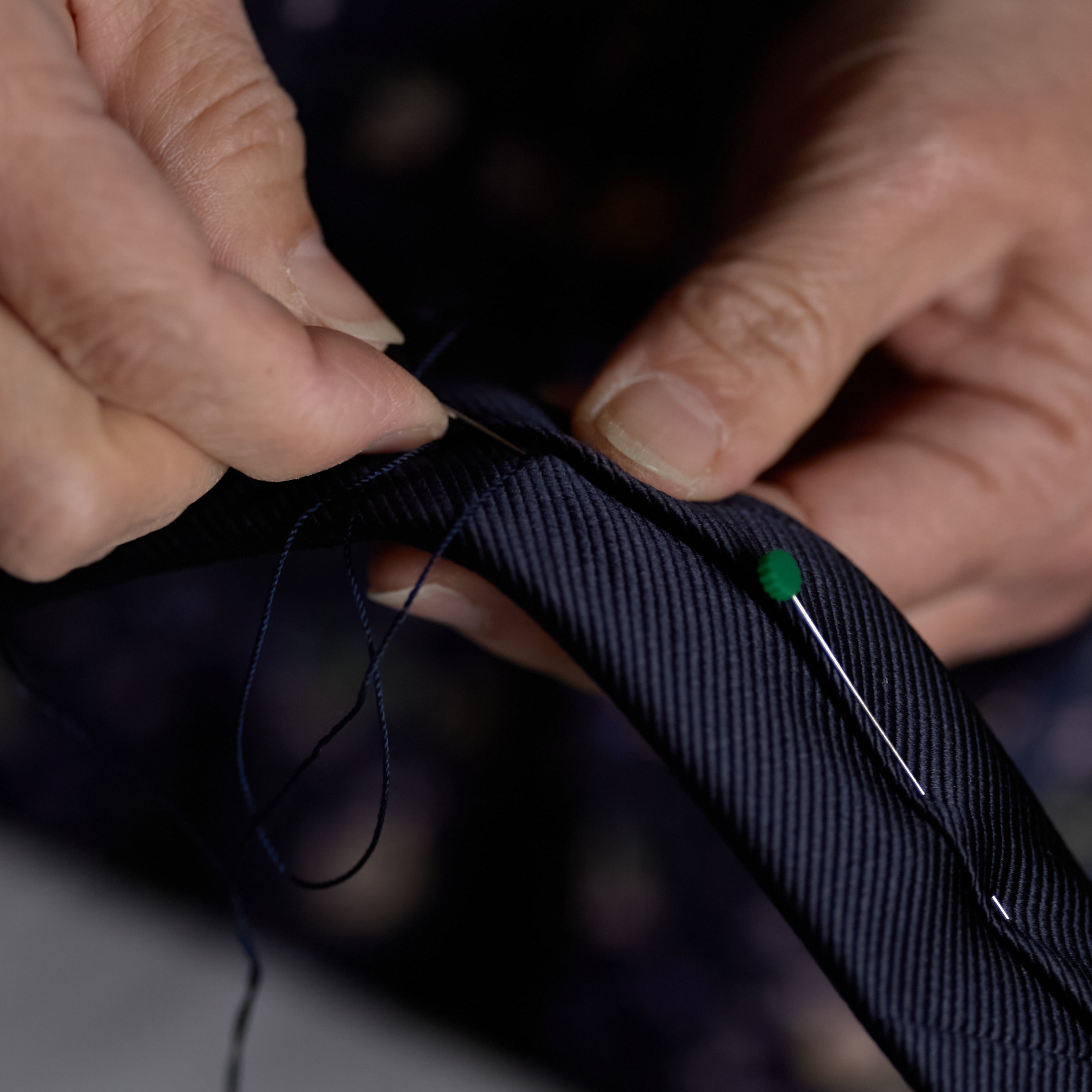
Twisting threads, bundling them, and twisting them further.
Then braiding them into cords, and tying them.
The process itself embodies the philosophy of "weaving and tying."
This small loop contains:
- Japanese tradition
- Reinterpretation of technology
- An uncompromising attitude towards materials
-
And passion
Everything is contained within.
Not the main character, but a symbol.

We are the supporting role.
The main character is always the customer who wears it.
However,
the essence lies in what is unseen.
The braided cord loop is not meant to be loud or boastful.
It is COCON's quiet sign,
understood only by those who notice it.
It is a small, yet unwavering identity,
for our existence to be loved for 100 years to come.